
How to Vet a Fishing Charter Before You Book in Australia
Learn how to check licences, insurance, safety records, reviews and pricing before you book any Australian fishing charter operator.
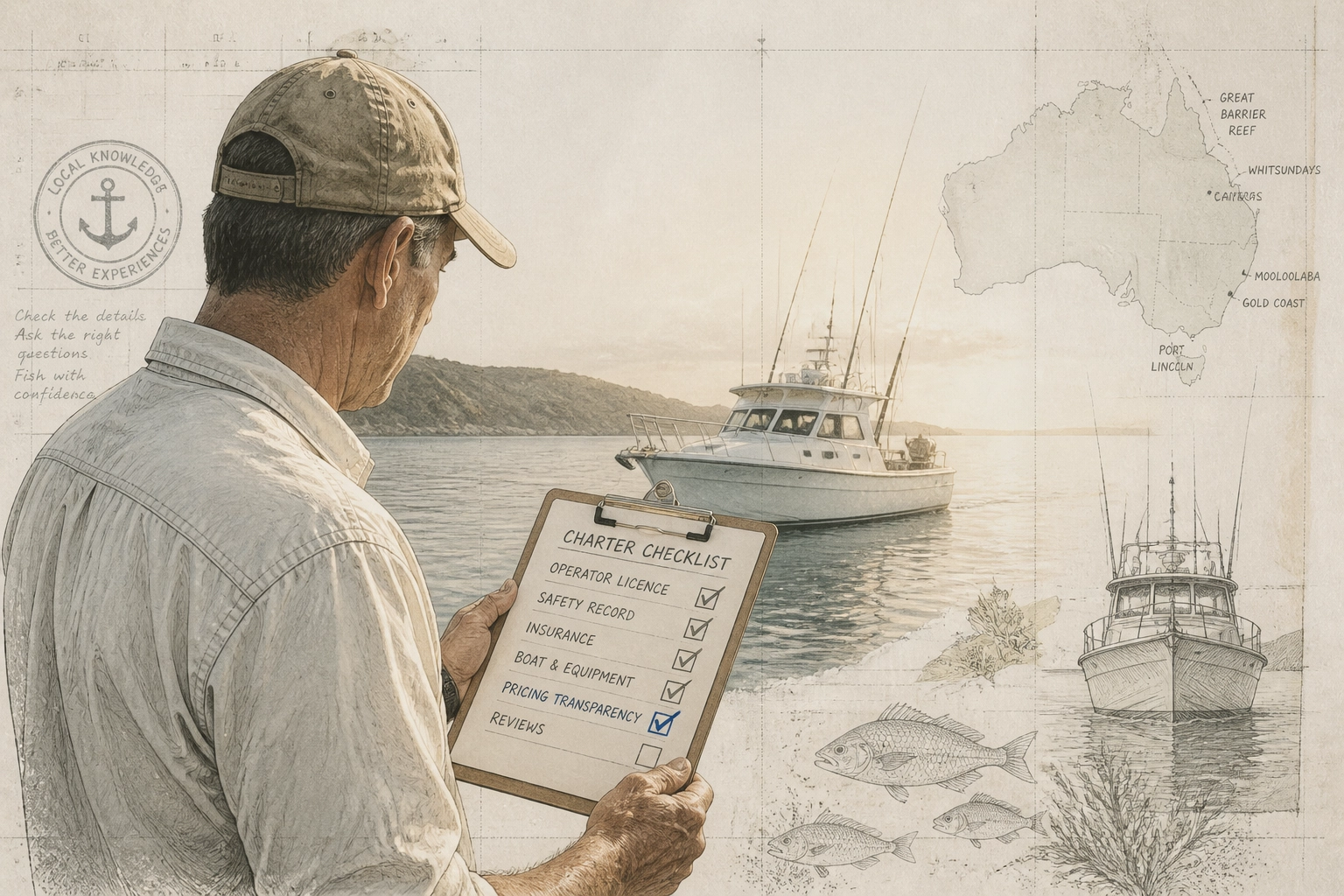
A glossy website and a gallery of trophy fish do not prove a fishing charter is safe, legal or worth your money. In Australia, charter and guided fishing trips operate under a mix of federal and state rules, and the details that matter most are often buried in certificates, insurance policies, safety records and review histories. If you are new to booking charters, this guide will show you how to vet an operator before you pay a deposit.
You will learn why careful checking beats trusting a polished brand, what Australian rules actually apply to charter operators, and how to work through five practical checks: licensing and skipper qualifications, insurance cover and what it should include, safety records and equipment, incident history, verified reviews, and clear pricing without hidden costs. I will also cover red flags that should end the conversation and give you a pre-booking checklist you can use in minutes. FSHNTRP.au brings these checks together in one directory, so you can compare local operators with evidence rather than hope. Book with confidence, not hope.
Why Vetting a Charter Operator Beats Relying on a Shiny Website
A polished booking page tells you nothing about whether the skipper holds a current AMSA certificate, whether the vessel is in survey, or whether the operator carries passenger liability cover. Pretty photos and confident copy are marketing, not evidence.
It is tempting to compare price and photos first, but that approach lets a poorly run operator outshine a careful one on marketing alone. This guide flips that order: verify first, compare second.
Vetting can be done before you pay a deposit, working through each check in turn. Australian charter businesses sit across federal and state systems. Because licensing spans federal and state systems, there is no single badge to search for, you verify the individual pieces: AMSA certificates of operation under national law, skipper competency, survey status, insurance and state fisheries rules.
You can run these checks while comparing options, such as when you compare Melbourne fishing charters for Port Phillip Bay.
What Australian Rules Actually Apply to Charter Operators
That absence of a single badge is because two regulators are usually in play. The Australian Maritime Safety Authority (AMSA) handles national commercial vessel and crew certification. Your state or territory marine safety agency handles vessel survey, safety equipment and local operating conditions.
AMSA issues domestic certificates of competency, including Coxswain and Master grades. Which grade your skipper needs depends on vessel size and how far offshore the trip runs. If they cannot name it, keep looking.
State fisheries agencies control the fishing side: what a charter may take, bag limits, reporting obligations and any charter fishing licence requirements. These differ by jurisdiction.
Business registration matters too. A legitimate operator should give you an ABN you can check on the Australian Business Register in seconds, plus a registered business name. AMSA administers the Certificate of Competency under national law.
Do not assume overseas rules translate. The United States runs a dockside examination program for commercial fishing vessels under a different federal scheme; use Australian sources only.
Check 1: Licensing and Skipper Qualifications
Now that you know who regulates what, start with the person at the wheel.
Ask for the certificate, not the job title
Ask directly which AMSA certificate of competency the skipper holds, what grade it is, and how long they have held it. Certificates are issued under Marine Order 505, so a genuine answer will name a current grade such as Coxswain or Master. Vague replies like "fully qualified" tell you nothing.
Match the grade to the trip
Bigger vessels and offshore grounds call for higher certificate grades. Ask what grade the skipper holds and whether it covers the area you intend to fish. If they cannot say, assume the answer is no.
Verify the vessel as well
Ask for the AMSA vessel identifier or state registration number, then confirm the boat is currently in survey for commercial operations, since survey is a separate requirement from crew certification. Cross-check the claimed grade against AMSA's published list of certificates. An operator who cannot name the regulator or the certificate has answered your question. Keep looking.
Check 2: Insurance Cover and What It Should Include
Once licensing and survey status are confirmed, move to insurance. Ask for a certificate of currency for public liability insurance. Check that the policy is current, names the operating entity you are paying, and covers commercial charter activity. If the certificate is vague, request the full policy schedule.
Ask separately about passenger liability and hull cover, since the scope of a public liability policy may vary. Confirm cover applies to your specific vessel and activity before assuming it is sufficient, including offshore trips if booked.
Check the requirements in your departure state, since state marine agencies each set their own vessel-safety conditions alongside the national system. For example, Queensland's commercial ship handbook treats any vessel used for financial reward as commercial, and NSW commercial vessel rules apply to charter operations there.
An operator who treats an insurance question as unreasonable is a red flag. Well-run businesses keep these documents on hand and send them without argument.
Check 3: Safety Records, Equipment and Incident History
Insurance documents settle one risk. Safety is next. Ask for the vessel's safety equipment list, including life jackets, emergency signalling devices, first aid supplies and fire equipment, and confirm each item is present and in date. For the mandatory requirements, check AMSA's domestic commercial vessel guidance directly. Vague assurances are not enough.
Then request the date the vessel last passed its survey or safety inspection. A reputable operator can give the exact month and year, not a general claim. AMSA's owner and operator obligations sit behind that survey system.
Searching the operator's name alongside terms like 'incident', 'rescue' or 'court' in news archives is a practical starting point, since no single public portal consolidates all records.
Ask how much sea time the skipper has and whether trips run in the forecast conditions for your date, not only on calm days. Ask whether the operator provides a written safety briefing, what the weather cancellation procedure is, and how many crew will be aboard. These are reasonable questions for any reputable operator.
Check 4: Verified Reviews and What Genuine Feedback Looks Like
Safety records tell you how an operator prepares. Reviews tell you how they behave once you are on board. Read them as evidence, not as a score.
Look for reviews spread across an extended period, not a burst concentrated in a short window. A sudden cluster of near-identical reviews suggests a campaign rather than a track record. Then read the two and three star reviews first. They tend to describe the reality: cramped boats, cancelled trips, surprise costs. Five star reviews often describe the weather.
Genuine feedback names specifics: the skipper, the ramp, the species caught, the bait used. Generic praise could be written by anyone. The ACCC's December 2023 online review sweep found concerns about review practices, including fake or undisclosed incentivised feedback, at 37% of the businesses it examined.
Treat "verified" as a claim to interrogate. Ask how the site establishes that a reviewer actually completed a booking; a credible platform will have a clear answer. Finally, cross-check at least two platforms, because a single feed can be curated. A directory like FSHNTRP.au lets you compare reviews alongside operator details in one place.
Check 5: Pricing Transparency and Hidden Costs
Reviews reveal how an operator behaves after the fact; pricing tells you how they behave before you pay. Australian consumer law prohibits misleading pricing. Fees revealed only after you commit are a recognised drip-pricing problem, treat any gap between the headline figure and the final charge as a warning sign.
 Check 5: Pricing Transparency and Hidden Costs
Ask what is excluded: bait, tackle hire, fishing licences, filleting, ice, fuel levies, national park or ramp fees and crew tips. Then confirm the deposit amount, payment method and the refund and cancellation policy in writing, including what happens if your trip is cancelled for weather. Mandatory charges should be disclosed upfront.
Group and private charters price differently. Ask how they differ, and whether a minimum booking number changes the per person rate, so you compare like with like.
Before paying anything, request the final figure in a written quote or booking confirmation. A reputable operator will put inclusions, exclusions and totals in writing without hesitation.
 Red Flags That Should End the Conversation
A written quote means little if the operator fails these tests. End the conversation when any of these appear.
They cannot name the regulator (AMSA or your state marine agency), the skipper's certificate, the vessel identifier or the insurer. Legitimate operators answer these without hesitation.
Payment is pushed off-platform, by bank transfer to a personal account, or in cash with no receipt. Pay the business entity, through traceable channels, and always get a receipt.
Reviews cluster in a short window, read almost identically, or come from accounts with no other activity. That pattern suggests fabrication, not feedback.
Safety questions get deflected with "we have never had a problem" instead of specifics about equipment, crew and procedures. A current safety management system requires documented answers, so evasion is a warning.
Pricing changes between enquiry and booking, extra fees appear only after the deposit, or there is no ABN, registered business name or fixed departure point. Any one of these is enough to stop.
With those red flags ruled out, use the pre-booking checklist to lock in your trip.
Your Pre-Booking Checklist
If no red flags surfaced, run this checklist before you pay a deposit.
Confirm the operator's ABN and registered business name, then record the skipper's AMSA certificate type and the vessel's survey or registration details.
Request the certificate of currency for public liability and passenger cover. Check that the policy names the entity you are actually paying.
Ask for the safety equipment list, crew numbers, departure ramp, and the weather cancellation and refund policy.
Read reviews on at least two platforms. Focus on the most recent and most critical comments, not the average score.
Get inclusions, exclusions, total price, deposit and refund terms in writing. Compare two or three operators in a single view; FSHNTRP.au helps by placing operator details and reviews side by side instead of hunting across dozens of sites.
Book With Confidence, Not Hope
The checklist only works if you actually run it. Licensing, insurance, safety, reviews and pricing each take minutes to verify, and together they give you a factual basis for choosing an operator rather than guessing. Ask for documents, not assurances. A Certificate of Operation, a certificate of currency, a survey date: these are facts.
Repeat the process every time. Ownership changes, skippers move between operators and vessels are sold or re-surveyed, so last season's good experience proves nothing about this season's trip.
Compare two or three operators on FSHNTRP.au before you commit, using the documents and quotes you have collected.
Conclusion
Run the five checks before every booking, ownership, skippers and vessels change between seasons. Choose the operator who answers with evidence, not assurances, and book with confidence.